


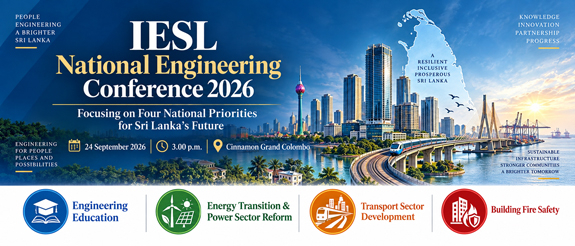
IESL National Engineering Conference 2026 to Focus on Four National Priorities
The Institution of Engineers, Sri Lanka, will hold the National Engineering Conference 2026 on 24 September 2026 from 3.00 p.m. at Cinnamon Grand Colombo. The conference will bring together policymakers, senior government officials, engineers, academics, industry leaders, investors and development partners to discuss practical solutions for several important national challenges.
NEC 2026 is designed as more than a professional conference. IESL will present four policy papers prepared by engineering professionals and invite the relevant authorities and stakeholders to consider practical actions for implementation. The four areas are engineering education, energy transition and power sector reforms, transport sector development and building fire safety.
The first area focuses on engineering, technology and technical education. Sri Lanka needs an education and professional development system that responds to national needs while maintaining internationally recognised standards. The proposed policy seeks clearer categories for Engineers, Engineering Technologists and Engineering Technicians, together with defined competencies, qualifications and career pathways. It also highlights the importance of accreditation, workforce planning and stronger links between education, industry and professional practice. A well-planned system can provide young people with clearer opportunities while ensuring that the country develops the skills needed for future growth.
The second area is energy transition and power sector reform. The report finds that the main challenge is now implementation rather than the absence of policy. Renewable energy development must be managed as part of an integrated power system. Expansion of solar and wind generation must be supported by stronger transmission and distribution networks, energy storage, forecasting, demand management and system control. The sector must also balance energy security, reliability, affordability, financial sustainability and environmental responsibility. The report calls for better planning, stronger institutions, improved procurement, transparent tariffs, investor confidence and measurable performance.
Transport is the third priority. The proposal is to establish an integrated multimodal people-centred public transport system that provides fast, affordable, reliable, and seamless connectivity between cities, townships, economic centres, and rural nodes. The proposal considers an integrated fare and ticketing system, with first- and last-mile connectivity embedded into a national digital platform. Expected national-level benefits include reduced travel time, manageable congestion, reduced fuel consumption, lower logistics costs, enhanced productivity & improved regional connectivity.
The fourth area addresses building fire safety. Sri Lanka currently has fragmented responsibilities and no single national authority responsible for the continuous regulation of building fire safety. The proposed framework calls for a National Building Fire Safety Act and an independent National Fire Safety Authority. It also proposes regular inspections, certification, clear technical standards, professional review and effective enforcement. These measures are intended to protect lives and property and create consistent safety standards across the country.
Through NEC 2026, IESL aims to bring engineering knowledge closer to national decision-making. The value of the conference will ultimately depend on how effectively these proposals are reviewed, developed and implemented. By bringing government, professionals, academia and industry together, NEC 2026 provides an opportunity to turn sound engineering ideas into practical national action.

